Showing posts with label aq khan. Show all posts

Wednesday, February 24, 2010

American Conspiracy Theories

In her column today, renowned defense analyst Dr. Shireen Mazari surprises her readers when she says that instead of appreciating Pakistan's cooperation, US officials and media have launched a campaign of conspiracy theories against Pakistan.

She identifies three threads: CIA organizing a conference in Thailand dedicated to Pakistan's disintegration, fresh attacks in the US media on Pakistan's judiciary to protect the pro-US government in Islamabad, and belittling Pakistani help in America's faltering war in Afghanistan.

Here's a quote:
"In the coming days we should gear up for a new nuclear related hype building up in the US media. Unfortunately, Dr Khan’s “letters” have been purchased by a leading US newspaper and will be used to target Iran. In the process Pakistan will also be targeted - killing two birds with one stone, so to speak. Would that our government undertake some proactive measures with the Iranians to deflect this new campaign but it hardly seems likely. So we need to brace ourselves once again for an onslaught against our nuclear capability and accusations of proliferation at a time when the US continues to proliferate to Israel and, post the 123 Agreement with India, to this South Asian aspiring hegemon."
Click here to read the full column.


Tuesday, November 10, 2009

Shireen Mazari On Seymour Hersh

In Bob Woodward’s book, “Bush at War”, he recalls how when he (Woodward) quoted Hersh to Bush, the latter replied that Seymour Hersh was a liar! Hersh’s article “Defending the Arsenal” in The New Yorker (November 16, 2009) has predictably caused a stir in Pakistan. But this always happens after the event; after foreign journalists have been given excessive access into the corridors of power in Pakistan. So it has been with Hersh. Now the Ministry of Foreign Affairs (MFA) claims Hersh has a well-known “anti-Pakistan” bias. If that is the case, then did the MFA give an official perspective on how much access Hersh should have been given in Pakistan? Did they advise the President to avoid meeting this man or did they give any official brief to the President on what to say to him on sensitive issues? Clearly, the Zardari meeting with Hersh has no reflection of the MFA or any official Pakistani position. Instead, there is a reflection of ignorance with the President declaring that our army officers are “British-trained”!

CLICK HERE TO READ THE FULL COLUMN


Peter Chamberlin: Why Not Criticize The Army, Ahmed?


US journalist and commentator Peter Chamberlin [Therearenosunglasses's Weblog] makes some insightful comments on my report below.  He has written with insight on Pakistani affairs.  He believes Pakistani military cooperation with US plans for our region is an important part of the problem and that Pakistani patriots are giving the Pakistani military a pass on its role.  Like the Pakistani society, opinions and analysis vary within the Pakistani military on US strategic role in our region. Mr. Chamberlin's comments here should help the debate. Read his comments in red below.

By PETER CHAMBERLIN

Tuesday, 10 November 2009.

WWW.AHMEDQURAISHI.COM

Ahmed,

I felt like commenting on your fine report, when I posted on my website.  I posted it as a comment on the article, but I thought you might like to see it as it was written.  Keep hammering, maybe reason might persuade your leaders to oppose mine.

Peter

American Psyops Destroying Pakistani Morale

[Ahmed is a great patriotic defender of Pakistan and he always calls the political leaders out when they sell-out.  Like most Pakistani patriots though, he is hesitant to criticize the Army for the trouble that is boiling over there, even though Army cooperation with the United States is perhaps the biggest problem of all.  Like I have been trying to point out for a couple of years, if the Army continues to cooperate with US planners and behind the scenes maneuvers, then Pakistan will not likely survive much longer.  The Army must convince Obama that it works for the Pakistani people and not for him.  It does this by resisting American calls for civil war and restoring all the displaced Pashtuns back to their homes and filling them with the will to resist.]

Nuclear Doubts: Pakistani Weakness Is Eroding Internal Morale, Fast

By AHMED QURAISHI
Tuesday, 10 November 2009.

ISLAMABAD, Pakistan—Two curious aspects of the New Yorker story on Pakistan's nuclear arsenal is that the report singles out the Pakistani military – and not the civilian government – as partner in alleged secret negotiations with the Obama administration to secure Pakistan's nuclear weapons.  The other is the objective behind leaking the story – if indeed some US officials helped in leaking details – since the story only serves to make it more difficult for Pakistani officials cooperating with Washington on the nuclear question.

[Strange as it seems, that is the way that the CIA undermines nations--it purposely complicates situations it wants to change, so that it can knock them down later.  It is of strategic value to keep the nuclear issue in conflict.  It is not really looking for cooperation on the nuclear issue, rather it is looking for complete capitulation to American Zionist demands.]

In May, when Boston Globe published a similar story quoting unnamed and unverifiable sources revealing that Pakistani officials have accepted a proposal to ship some highly enriched uranium to the United States for disposal, there was no reference whatsoever to Pakistani military.  The Globe depicted the talks as a government-to-government exercise.

For all intents, the latest story seeks to embarrass the Pakistani military.  This probably explains the immediate reaction of the US Ambassador to Pakistan Anne W. Patterson.  Not that she actually denied the alleged talks.  Her written statement was carefully worded to deny her government's "intention to seize Pakistani nuclear weapons or material."

[Patterson was probably telling a diplomat's version of the "truth," they don't intend to "seize" Pakistan's nukes, they expect the Army to simply hand them over.]

The element of embarrassment also explains the statement of Pakistan’s Chairman Joint Chiefs of Staff Committee General Tariq Majid, who made it a point to respond to the question, 'How much does US really know about Pakistan's nuclear program?'  In a sharp public retort uncommon to Pakistan's top military brass, Gen. Majeed answered, ‘Only that much as they can guess and nothing more’.

Important parts of Mr. Seymour Hersh's investigative story remain unaddressed.  No government or military official has confirmed or denied the revelation in the New Yorker that former President Pervez Musharraf shared with US officials information about the number of warheads, their locations and their security plan.  Considering the embarrassing concessions that he gave the Americans (he allowed US diplomats, officials and military personnel unprecedented privileges at Pakistani airports at a time when Pakistani officials were humiliated on entry to US.  Pakistan has withdrawn those concessions.)

[There should be no doubt in Pakistan, even within the Army, that Musharraf handed the country to Bush and waged war against the people afterwords, to please him.  Why wouldn't  the keys already be in US hands?]

(It is also important to question some of Mr. Hersh's findings, which border on the ridiculous.  The last time Mr. Hersh visited Pakistan was five years ago by his own statement.  Yet he concluded that since the few politicians, journalists and retired generals he met this time did not offer him Johnny Walker Black this must be a sign of growing religious extremism in Pakistan and in the ranks of Pakistan military.  At other places, he has exaggerated the impact of two retired army officers that he interviewed on soldiers and middle rank officers.  Mr. Hersh appeared to have made little effort to use his visit to the country to try to understand the real Pakistan. Instead, he felt comfortable regurgitating media stereotypes. Which is fine since his report fits in with the overall US political and military policy thrust with regards to Pakistan.)

Mr. Hersh's report comes six months after the Boston Globe story that broke the news on behind-the-scenes talks between Islamabad and Washington on US proposals to secure Pakistan's nuclear weapons, including a US suggestion to ship out Pakistani uranium.  No one in Islamabad denied the story at the time.  The fixed Pakistani response to such stories has not changed much in recent years: that Pakistan has an excellent command and control regime and that Pakistan does not need outside help to secure its arsenal.

So, is the Pakistani government or military really talking secretly with the Americans on how to secure Pakistani nukes?

One explanation that retired military officers are giving is that Pakistani officers may be talking nukes to the Americans but not giving them the right information.  If true, this policy line seeks to keep the Americans engaged with Pakistan without allowing Washington any real access.

This is not farfetched. Pakistani civilian and military governments have perfected a uniquely Pakistani version of the American idiom, 'to roll with the punches and survive to fight another day.'  Only that Pakistan never really fights even for what is its legitimate right.  Under this policy, Islamabad has accepted on several occasions to play along, live with the accusations and insinuations about its nuclear program, and hope to stall, engage, and win over the antagonistic elements of the Washington establishment, both political and military.

But the latest report takes the debate to a new level.  Pakistani officials grappling with the PR aspect of this story need to consider the following:

1.       The latest report is particularly demoralizing for ordinary Pakistanis, in the backdrop of an overall deteriorating strategic environment for Pakistani interests, internal and external.  Pakistan's national security managers, civilian and military, need to pay attention to the hypothetical threshold of national morale.  Dangerously low levels of national morale could prove fatal in case of war with India or a US-led military invasion of Pakistani territory from Afghanistan.

[Wearing-out an opponent, without having to actually fight, is the purpose of CIA and military psyops.  When, and if, Pakistani morale sinks so low that agency planners expect complete capitulation with the next shock, then the final shock will soon come, psychological assault will intensify.  It is the "shock doctrine" and the theory of "learned helplessness" rolled into one.  The close cooperation between American and Pakistani military leaders makes it highly unlikely that Kayani and the generals don't understand what is happening.  By looking the other way so often, whenever US operatives are taking actions that are harmful to Pakistan, the Army shares in the guilt for what is being done.   This is the deadly problem that will finish Pakistan off, if left as is.]

2.      Is there someone in Washington, within its political, military and intelligence communities that might have an interest in embarrassing Pakistani officials who are allegedly engaged in secret nuclear talks with Washington?  Is someone trying to sabotage policy initiatives of the Obama administration?  In such a case, Pakistani officials – especially in the Pakistani intelligence community – need to give more weight to reports that anti-Pakistan activities orchestrated on Afghan soil cannot happen without some level of American involvement.

[Ahmed is being too generous concerning American intentions, but he is dead-on about US and NATO forces being complicit in any Indian action against Pakistan from Afghani soil.  Launching attacks against Pakistan from US-controlled territory would require US consent, just like in the case of Israel attacking Iran through US-controlled airspace, it can't be done without American permission.]

3.      That the US media continues to cause tremendous damage to Pakistan's reputation and standing in the international community.  Pakistan is receiving enemy treatment from the US media.  Pakistani officials must understand that US media cannot mount similar attacks on other countries such as Turkey and Egypt because leaderships in those countries generally keep US officials on a leash and leverage Washington's strategic needs to their favor. In Pakistan, we have a ruling elite that is micromanaged from Washington, thanks to a deal that former President Musharraf signed with Washington and London.

[Pakistan will continue to be a pariah nation because of the armies of Islamists that it has trained for the CIA. Until Kayani and the generals stop covering-up what amounts to a shared criminal enterprise run for the CIA, Pakistan will take the fall for the entire operation, by itself, America is off the hook. The world is slowly coming to realize what was done in FATA and NWFP, because the graduates of the militant academies which were established there have been plying the trade they learned there all over the world.  The world is holding Pakistan accountable for the terrorism these militants are commiting, no matter what.    Pakistan will go down alone, unless the generals prove to the world that this has been an American enterprise all along, which they merely been managing and operated under a deadly contract that began in 1979.]

4.      The New Yorker report harms the image of the Pakistani military leadership in the eyes of the soldiers and officers in middle and lower ranks.  This is especially relevant to the debate raging in official US circles about a mutiny within the Pakistan army.  Some American policymakers are deliberately using Afghanistan to push Pakistan to the wall in the hope that instability in Pakistan would reach a level where it could trigger a mutiny inside the Pakistani military against both the military leadership and the government.  Anyone who knows Pakistan will instantly understand that this notion is exaggerated, but this US debate should tell Pakistan's military leadership and people something about the destructive line of policy thinking that Washington is pursuing in Pakistan's neighborhood.

[Some of the attacks, even some being committed on the Army,  are being done by "former" military and ISI men, usually blamed on Taliban.   Consider the officers involved in the  attacks on Musharraf and the attack upon GHQ .  There is secret cooperation between the CIA and some unnamed officers of the Army on some level that amounts to waging war against the locals.]

Common wisdom in both the Pakistani political elite and some parts of the military bureaucracy says that 'engaging' the Americans on the subject of the security of Pakistani nukes can be beneficial to Pakistan. It would keep Washington engaged.  It would provide opportunities to milk the Americans of more aid money.

But no one in the policymaking circles is apparently weighing the downside: The 'engagement' is emboldening the Americans.  The 'engagement' – or secret talks, call them whatever you want – are sending the wrong signals to ordinary Pakistanis at a time when more of our people are convinced that Pakistan's troubles stem from American failures in Afghanistan.

Pakistani schools and colleges are under attack when those in Iraq and Afghanistan are safe.  This is happening because of American policy blunders and not just because of extremism inside Pakistan.  Our problems are also the result of Islamabad refusing to submit completely to the US military strategy that wants to give India a larger role in Afghanistan.  Pakistan, with a strong military and intelligence setup, is an obstacle in this strategy.

[That is precisely why American planners are working so hard to take Pakistan out of the way.  If they succeed in destroying the morale of the brave people of Pakistan, then a whole new level of pain will sweep over the land, with the idea of washing Pakistan back upon Indian shores.]

© 2007-2009. All rights reserved. AhmedQuraishi.com & PakNationalists

The original report is posted here


Email from a reader, Mr. Zeeba Khan to PakNationalists:

I think the problem in this country is that there is a race going on between the civilian and the military leadership to excel in terms of loyalty to the Americans. The interests of 170 mn people of this country is of no consequesnce. The most important thing is to pursue US interests, so that personal gains can be reaped from the situation. The accusation by  Seymour Hersch has been accepted by the top military brass by stating that they are engaging the Americans. Whether these engagements lead to pursuing Pakistan's interests or the personal interests of the 'engagers' remains to be seen. In the past personal interests have triumphed over national interests.

There is evidence to show that Pakistan army is totally committed to US interests. The military operations in Swat and Waziristan are proofs. Even when proofs of US involvement in Pakistan were found with the discovery of US arms from Swat (or Waziristan) ISPR spokesperson Gen Athar Abbas stated that these were stolen US arms. The army found the arms and ISPR spokesperson knew even before any investigation had been conducted that these were stolen arms. US interests are closer to his heart than Pakistan's.    


Nuclear Doubts: Pakistani Weakness Is Eroding Internal Morale, Fast


Seymour Hersh might have come up with some absurd findings, like concluding that religious extremism has multiplied in Pakistan because no one offered him Johnny Walker Black during his recent visit.  But apart from that, Pakistan's national security managers should sit up and take notice of one glaring fact: The US media and some circles in the Washington establishment are behind the worst global demonization campaign against Pakistan.  Now this is denting national morale and forcing Pakistanis to question if their military is capable of defending the nation, since politicians have proven to be a disaster.

By AHMED QURAISHI
Tuesday, 10 November 2009.

ISLAMABAD, Pakistan—Two curious aspects of the New Yorker story on Pakistan's nuclear arsenal is that the report singles out the Pakistani military – and not the civilian government – as partner in alleged secret negotiations with the Obama administration to secure Pakistan's nuclear weapons.  The other is the objective behind leaking the story – if indeed some US officials helped in leaking details – since the story only serves to make it more difficult for Pakistani officials cooperating with Washington on the nuclear question.

In May, when Boston Globe published a similar story quoting unnamed and unverifiable sources revealing that Pakistani officials have accepted a proposal to ship some highly enriched uranium to the United States for disposal, there was no reference whatsoever to Pakistani military.  The Globe depicted the talks as a government-to-government exercise.

For all intents, the latest story seeks to embarrass the Pakistani military.  This probably explains the immediate reaction of the US Ambassador to Pakistan Anne W. Patterson.  Not that she actually denied the alleged talks.  Her written statement was carefully worded to deny her government's "intention to seize Pakistani nuclear weapons or material."

The element of embarrassment also explains the statement of Pakistan’s Chairman Joint Chiefs of Staff Committee General Tariq Majid, who made it a point to respond to the question, 'How much does US really know about Pakistan's nuclear program?'  In a sharp public retort uncommon to Pakistan's top military brass, Gen. Majeed answered, ‘Only that much as they can guess and nothing more’.

Important parts of Mr. Seymour Hersh's investigative story remain unaddressed.  No government or military official has confirmed or denied the revelation in the New Yorker that former President Pervez Musharraf shared with US officials information about the number of warheads, their locations and their security plan.  Considering the embarrassing concessions that he gave the Americans [he allowed US diplomats, officials and military personnel unprecedented privileges at Pakistani airports at a time when Pakistani officials were humiliated on entry to US.  Pakistan has withdrawn those concessions.]

[It is also important to question some of Mr. Hersh's findings, which border on the ridiculous.  The last time Mr. Hersh visited Pakistan was five years ago by his own statement.  Yet he concluded that since the few politicians, journalists and retired generals he met this time did not offer him Johnny Walker Black this must be a sign of growing religious extremism in Pakistan and in the ranks of Pakistan military.  At other places, he has exaggerated the impact of two retired army officers that he interviewed on soldiers and middle rank officers.  Mr. Hersh appeared to have made little effort to use his visit to the country to try to understand the real Pakistan. Instead, he felt comfortable regurgitating media stereotypes. Which is fine since his report fits in with the overall US political and military policy thrust with regards to Pakistan.]

Mr. Hersh's report comes six months after the Boston Globe story that broke the news on behind-the-scenes talks between Islamabad and Washington on US proposals to secure Pakistan's nuclear weapons, including a US suggestion to ship out Pakistani uranium.  No one in Islamabad denied the story at the time.  The fixed Pakistani response to such stories has not changed much in recent years: that Pakistan has an excellent command and control regime and that Pakistan does not need outside help to secure its arsenal.

So, is the Pakistani government or military really talking secretly with the Americans on how to secure Pakistani nukes?

One explanation that retired military officers are giving is that Pakistani officers may be talking nukes to the Americans but not giving them the right information.  If true, this policy line seeks to keep the Americans engaged with Pakistan without allowing Washington any real access.

This is not farfetched. Pakistani civilian and military governments have perfected a uniquely Pakistani version of the American idiom, 'to roll with the punches and survive to fight another day.'  Only that Pakistan never really fights even for what is its legitimate right.  Under this policy, Islamabad has accepted on several occasions to play along, live with the accusations and insinuations about its nuclear program, and hope to stall, engage, and win over the antagonistic elements of the Washington establishment, both political and military.

But the latest report takes the debate to a new level.  Pakistani officials grappling with the PR aspect of this story need to consider the following:

1.       The latest report is particularly demoralizing for ordinary Pakistanis, in the backdrop of an overall deteriorating strategic environment for Pakistani interests, internal and external.  Pakistan's national security managers, civilian and military, need to pay attention to the hypothetical threshold of national morale.  Dangerously low levels of national morale could prove fatal in case of war with India or a US-led military invasion of Pakistani territory from Afghanistan.

2.      Is there someone in Washington, within its political, military and intelligence communities that might have an interest in embarrassing Pakistani officials who are allegedly engaged in secret nuclear talks with Washington?  Is someone trying to sabotage policy initiatives of the Obama administration?  In such a case, Pakistani officials – especially in the Pakistani intelligence community – need to give more weight to reports that anti-Pakistan activities orchestrated on Afghan soil cannot happen without some level of American involvement.

3.      That the US media continues to cause tremendous damage to Pakistan's reputation and standing in the international community.  Pakistan is receiving enemy treatment from the US media.  Pakistani officials must understand that US media cannot mount similar attacks on other countries such as Turkey and Egypt because leaderships in those countries generally keep US officials on a leash and leverage Washington's strategic needs to their favor. In Pakistan, we have a ruling elite that is micromanaged from Washington, thanks to a deal that former President Musharraf signed with Washington and London.

4.      The New Yorker report harms the image of the Pakistani military leadership in the eyes of the soldiers and officers in middle and lower ranks.  This is especially relevant to the debate raging in official US circles about a mutiny within the Pakistan army.  Some American policymakers are deliberately using Afghanistan to push Pakistan to the wall in the hope that instability in Pakistan would reach a level where it could trigger a mutiny inside the Pakistani military against both the military leadership and the government.  Anyone who knows Pakistan will instantly understand that this notion is exaggerated, but this US debate should tell Pakistan's military leadership and people something about the destructive line of policy thinking that Washington is pursuing in Pakistan's neighborhood.

Common wisdom in both the Pakistani political elite and some parts of the military bureaucracy says that 'engaging' the Americans on the subject of the security of Pakistani nukes can be beneficial to Pakistan. It would keep Washington engaged.  It would provide opportunities to milk the Americans of more aid money.

But no one in the policymaking circles is apparently weighing the downside: The 'engagement' is emboldening the Americans.  The 'engagement' – or secret talks, call them whatever you want – are sending the wrong signals to ordinary Pakistanis at a time when more of our people are convinced that Pakistan's troubles stem from American failures in Afghanistan.

Pakistani schools and colleges are under attack when those in Iraq and Afghanistan are safe.  This is happening because of American policy blunders and not just because of extremism inside Pakistan.  Our problems are also the result of Islamabad refusing to submit completely to the US military strategy that wants to give India a larger role in Afghanistan.  Pakistan, with a strong military and intelligence setup, is an obstacle in this strategy.

© 2007-2009. All rights reserved. AhmedQuraishi.com & PakNationalists
Verbatim copying and distribution of this entire article is permitted in any medium

Saturday, August 29, 2009

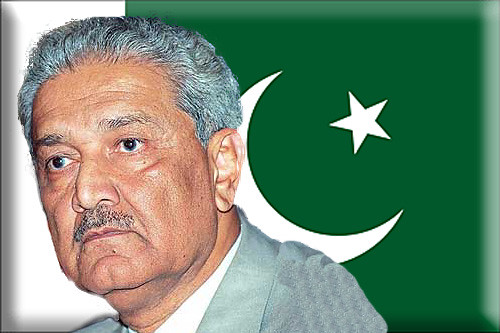
Anyone Still Interested In Kidnapping Dr. AQ Khan?


The credit for the two best-known cases of smuggling out nuclear scientists goes to Israel’s Mossad and Pakistan’s ISI. Israel kidnapped a renegade Israeli nuclear scientist. Pakistan helped one return home from Europe with the technology to build the bomb.

Both scientists were driven by noble impulses. The Israeli scientist, Mordechai Vanunu, wanted to expose his government's fevered push to produce nuclear weapons in a region that had none. The Pakistani scientist wanted to help his small country stand up to a nuclear-armed bully, India.

This is why Dr. A. Q. Khan, who has been much demonized by the Am-Brit media, is a hero to 180 million Pakistanis.

But a question begs itself: demonized for what?

Although former President Musharraf did a commendable job at shielding Dr. Khan from direct American access, the very act of forcing Dr. Khan to confess to something that is not a crime under any law was wrong.

Pakistan is not signatory to Nuclear Non-Proliferation Treaty. Islamabad could have simply told Washington and London to take a hike when both accused it of transferring technology to Iran and North Korea.

In fact, there was room for a deal: Ensure Pakistan's legitimate regional security requirements, including a credible nuclear deterrent in the face of Indian posturing, in exchange for avoiding any future Pakistani nuclear trade with North Korea.

By incarcerating Dr. Khan, Musharraf's Pakistan accepted undue pressure. We will have to pay for a long time, especially in bad reputation, for showing weakness when we should not have.

But since Pakistan did accept the 'crime', several international parties can make a case now for pursuing Dr. Khan if he is set free of the security detail that accompanies him. The Americans have been twisting Pakistani arm for some time demanding US officers be allowed to interrogate Dr. Khan.

Washington has direct interest in nuclear technology transfer to Iran and North Korea. But America has also been silently worried about the Pakistani nuclear program. In 1978, when there was no threat of extremists overtaking Pakistani nukes, CIA used the US consulate in Karachi to recruit 12 Pakistani nuclear scientists and technicians. The CIA ring was assigned the task of sabotaging several nuclear sites to scuttle the nascent Pakistani nuclear program and make it look like a series of unfortunate accidents by an inexperienced nuclear power aspirant.

The Israelis are also quite active in the region: In India where military and intelligence cooperation is at a peak; and in Afghanistan, which is one of the countries Israeli intelligence service is using to encircle and penetrate Iran.

In February, London's Daily Telegraph ran a report quoting unnamed 'western intelligence sources' that said Israel was quietly assassinating Iranian nuclear experts. As proof, the newspaper said Mossad was behind the mysterious murder of Ardeshire Hassanpor, the top Iranian nuclear scientist at the uranium plant in Isfahan in 2007.

Why would anyone still be interested in laying their hands on Dr. A. Q. Khan, who has had no operational access to Pakistani strategic sites for at least a decade now?

Considering Pakistan's crippled security environment, exposed thanks to a heavy US overt and covert presence in the region, Dr. Khan faces a real threat of being kidnapped. Washington's spy network has been a failure so far in assessing the exact location of Pakistan's nuclear arsenal. The Americans have also failed, despite several attempts, to gain access to the 'triggers'. Under duress, like a Guantanamo-style interrogation, Dr. Khan can provide clues that could lead to understanding where and how Pakistan is safeguarding its nuclear capability.

Security officials in Pakistan will have to balance Dr. Khan's legitimate need to feel he continues to be a revered Pakistani hero with Pakistan's security requirements and needs. This is a tough balancing act considering that Dr. Khan's original incarceration and the subsequent demonization was contrary to Pakistani interest.

In July 2008, when a justifiably angry Dr. Khan gave a series of press interviews throwing out juicy details about Pakistan's nuclear history, I authored a report assessing threats to the well being of Dr. Khan should he decide to completely dispose off of the security detail provided to him.

Here are relevant excerpts:

ISLAMABAD, Pakistan—Dr. A. Q. Khan, Pakistan’s notorious nuclear scientist, is under threat of being kidnapped and bundled out of the country in a joint Israeli-American operation that could take the lid off Pakistan’s massive nuclear and strategic arsenal.

Pakistani security officials went on red alert in the last week of June 2008 after receiving information that Israel’s Mossad, possibly in a joint operation with some elements from CIA, is planning to kidnap Dr. Khan, who lives in a house in an Islamabad suburb, and take him out of the country. The officials are tightlipped about the source of the alert.

This possibility is literally Pakistan’s worst nuclear nightmare. All Pakistani scientists, technicians and other special staffers, retired and serving, working on the strategic weapons programs, follow security procedures to avert this possibility. Dr. Khan is the only retired senior scientist who is currently trying to break out of these procedures, creating a risk both for himself and for Pakistan. Islamabad has done a lot to protect him from foreign hands.

Dr. Khan no longer holds official access to Pakistan’s strategic facilities but is considered to be a treasure trove of information on Pakistan’s missile and strategic weapons, especially the two areas that bear his fingerprints: uranium enrichment technology and the development of Pakistan’s long range, nuclear capable Ghauri missile series.

The threat to Dr. Khan is part of a larger dilemma facing Islamabad these days regarding how to deal with the retired scientist. The government wants to relax his security detail assigned to him since his 2004 confession to running a clandestine proliferation network and the subsequent presidential pardon. The government wants to do this in order to calm the Pakistani public opinion that continues to see Dr. Khan as a mistreated national hero.

But the other side of the coin is the fact that Dr. Khan is privy to critical and classified information. There is no known threat to his life but he faces a real possibility of being kidnapped and shipped out of Pakistan to be debriefed by foreign interrogators. One Pakistani official puts this dilemma facing the Pakistani government this way, ‘How can we take a chance with this kind of a personality?’

Making matters worse is Dr. Khan himself, who has intensified his campaign of blackmailing the government into withdrawing his security detail and set him free of any security. Pakistani officials say Dr. Khan is a free man but that assigning him a security detail is based on threat assessments done by professionals.

[ … ]

Pakistan has firmly told everyone that Dr. Khan’s case is ‘closed.’ But the worrying aspect is that with a strongly pro-American PPP government in Islamabad, whose ambassador in Washington is keen to promote U.S. views and whose party cochairman, Mr. Asif Zardari, has used his recent international tour to confirm the presence of terrorist camps inside Pakistan, there is no towering politician or statesman left in the Pakistani capital who can come forward now and boldly defend the Pakistani position.

Alarmingly, Dr. Khan has moved the Pakistani Supreme Court to force the government to remove all security detail assigned to him. This obviously crosses a red line.

That is why Lt. Gen. Khalid Kidwai, the director of the Strategic Plans Division, which oversees the strategic weapons programs, came out on Saturday in Islamabad to say that Pakistan will protect its interest at any cost.

“There are international threats … [Dr. Khan] is being simplistic in his approach,” Gen. Kidwai told a group of Pakistani journalists during a special briefing over the weekend in Islamabad.

Although the days of the Cold War, with their intelligence intrigues, are behind us, the history of nuclear espionage and the stories of the kidnappings and mysterious disappearances of nuclear scientists are too serious and too fresh to be ignored.

Early last year, an Iranian scientist, Ardeshire Hassanpour, mysteriously died in Isfahan, Iran. He was connected to the Natanz nuclear facility which is under international spotlight. Reports suggested he was either killed by the Israeli Mossad or was eliminated by the Iranian government after he was found communicating with either American or Israeli agents. In either situation, this is a fresh and clear case that Pakistan’s immediate region is abuzz with covert activity targeting nuclear scientists and installations.

Interestingly, the credit for two of the best known cases of kidnapping a nuclear scientist and taking him to another country goes to Israel’s Mossad and Pakistan’s ISI. The Pakistani intelligence agency smuggled Dr. A. Q. Khan out from Europe to Pakistan, not to mention that it ran a clandestine operation for the purchase of prohibited equipment and recruitment of nuclear experts and technicians. So, it is safe to say that officials in Islamabad know what they are dealing with. And thus the threat perception [the chances of an A.Q. Khan kidnap] is not exaggerated.

On Sept. 30, 1986, Mossad drugged and smuggled out the rogue Israeli nuclear technician Mordechai Vanunu while he was en route in a plane from London to Rome. Vanunu was a disgruntled former employee of the Israeli nuclear program. In revenge, he handed over pictures and sensitive information to a British newspaper.

For those who think the Pakistani government is not fair to Dr. Khan, they should see what the Israeli government did to Vanunu.

According to a U.S. Web report, ‘Mordechai Vanunu spent 18 years in prison, including more than 11 years in solitary confinement. Vanunu was released from prison in 2004, subject to a broad array of restrictions on his speech and movement. Since then he has been briefly arrested several times for multiple violations of those restrictions, including giving various interviews to foreign journalists and attempting to leave Israel. In July 2007, Vanunu was sentenced to a further six months' imprisonment for speaking to foreigners and for traveling to Bethlehem.’

In comparison, Dr. Khan is not in detention. He is at his home with his family. He carries a cell phone, along with his family members. Recently, he has been allowed to take meals at restaurants, with some restrictions pertaining to timings in view of Dr. Khan’s security. The Pakistani authorities have been so generous with Dr. Khan that recently he has been free to give telephone and written interviews without any problem, which indicates that his telephone calls and written exchanges are not monitored or censored.

At no point did any Pakistani official misbehave with Dr. Khan. The reason for this generosity is that Dr. Khan might have wronged by getting involved in the proliferation business and self-enrichment, but he remains a man who served his nation well.

Lt. Gen. Kidwai of the Strategic Plans Division (SPD) and Gen. Ihsan-ul-Haq, the former head of the ISI, who questioned Dr. Khan in ten different ‘sittings’ back in 2004 always addressed Dr. Khan as ‘sir’ as a sign of respect.

The evidence of wrongdoing against the prominent scientist was so strong and damning that Dr. Khan changed his testimony from an initial denial to stopping at one point to say, ‘Enough is enough. Please ask the President to pardon me.’

Gen. Kidwai and the ISI chief conveyed to President Musharraf that Dr. Khan wanted to apologize and seek a pardon. ‘This is not personal,’ President Musharraf reportedly said, ‘He should apologize to the nation.’

This is where the idea for the famous television apology came up. The National Command Authority, the main federal agency in charge of the strategic assets and the parent organization of SPD, prepared an initial draft and handed a copy to Dr. Khan for his input. The process of finalizing the draft apology took at least three to four days as the draft of the apology letter ran back and forth between the officials and Dr. Khan, who made corrections to the draft with his own pen. This draft copy is available with the officials and contradicts Dr. Khan’s recent complaint that ‘a letter of apology was thrust in his hands at the President’s office and he was asked to read it on television.’

Now Islamabad is considering presenting the evidence against Dr. Khan before a limited group of neutral Pakistanis. The evidence cannot be made public due to the sensitivity of the information. But if Dr. Khan manages to convince the Pakistani court that he needs to be freed of all security around him, then the government will come forward with the evidence before a group of prominent Pakistanis in a closed door exercise. The purpose is to prove that Dr. Khan is not as innocent as he says he is, and, second, to ensure he retains the security detail provided to him in order to protect him from possible threats, including the reports of an Israeli-style kidnapping.

Pakistani authorities have a legal document that Dr. Khan approved. The document indicates that the presidential pardon was conditional on Dr. Khan not jeopardizing national secrets and provided that no new information emerges on his proliferation activities beyond what he has already confessed.

As for the latest report on a possible plan to kidnap Dr. Khan and take him outside Pakistan, it is not clear where the information came from. Officials are tightlipped. Islamabad closely monitors Indian activities in the region and there is evidence that Indian intelligence operatives in the past have tried to volunteer information on Pakistani nuclear sites to Israel and to certain Pakistan-averse lobbies in the United States.

But Pakistan’s nuclear and strategic weapons programs remain on a strong footing. The image of instability is the result of a political failure on the part of the political class in the country.

The military resolve remains intact. In fact, voices are rising now that say that Pakistan should not be apologetic about its past cooperation with North Korea. Islamabad is not signatory to the Non-Proliferation Treaty and its cooperation with North Korea was within the parameters of Pakistan’s own legitimate security and defense considerations and did not break any international law.

Any past and future Pakistani cooperation with the United States or the IAEA remains confined to two red lines set by Islamabad: One, no one can question Pakistan about the origins of its nuclear and strategic weapons programs, and, Two, Pakistan will not discuss at any level its nuclear cooperation with friends and allies. Iran and North Korea are the only exception because the two nations are already involved in multilateral talks about their programs.