Showing posts with label incredible india. Show all posts

Monday, September 19, 2011

India's Racism In A Foreign Mask


An Indian-origin Baroness, Shreela Falther [Mrs. Gary Denis Flather] accuses Pakistani & Bangladeshi families in UK of producing more children to get state benefits. She defends large Indian families by saying they don't count because they're educating their kids. No, really, that's what she said.

What she is doing is to show a red cloth to the British right wing bull. In other words, it is okay for British Indian families - the largest Asian migrant community - to continue milking the government for child benefits because these families are educating their children. The Pakistanis and Bangladeshis are not, according to the Indian-born baroness.

I highlight this story because it represents a trend. More and more Indian-origin migrants are being quietly recruited by Indian government to serve Indian objectives where possible. New Delhi has shown special interest in recruiting Indian migrants sitting in positions of influence in their adopted homelands. And nowhere is this more apparent than in the United States, where Indian-origin journalists, Congressional aides, and TV anchors are already part of a loose network linked to Indian government lobbyists in DC. The Indians have picked this bright idea from none other than AIPAC, the formidable pro-Israel lobby group.

This is why you see more and more influential Indian-origin migrants in influential countries raising issues that serve the Indian government. For example, these prominent Indians would attack Pakistan, highlight dangers from 'Islamic terrorism', underplay Kashmir genocide, downplay high rates of girl infanticide in India, etc.

In this example, the Baroness is playing to the British rightwing by suggesting economic threats from Pakistani- and Bangladeshi-origin migrants. What she doesn't say is that her community of Indian-origin Brits stand to benefit if the other two migrant communities are downsized. This is a serious conflict of interest. But at least she's working for the interests of a friendly foreign government. Is there a law in England against that?

I am glad that I am not the only one who has noticed Indian-born Mrs. Flather's racism. In fact, that's the exact word that came to the mind of a British blogger, Suzanne Cameron-Blackie, when she heard the baroness's tirade.

Wednesday, July 13, 2011

Krishna's Dirty India

India does it again. When a senior White House official announced delaying Pakistan aid, the Indian foreign minister coundn't hide his glee, more like a kindergarten bully than a foreign minister of a large-sized country.

He welcomed the US move and dumped a heap of propaganda lines on Pakistan.

I laugh no end when I read for US officials swearing to us that India means us no harm, that we are wrong to think the Indians will wage war on us any chance they get, etc.

US officials are desperate to give India a larger role in Afghanistan and Central Asia, and they firmly want Pakistan under Indian wings.

But the truth is, India is a country that can never even dream of entering a war with China. Its multibillion dollar armament drive is meant for Pakistan, which is an obsession for India's ruling elite.

India is a big country but with the brain of a mouse. In 1971, long before there were any pro-Pakistan freedom groups in Kashmir, and long before there was Lashkar-e-Tayyeba or even an intifada in Kashmir, India invaded Pakistan while Pakistanis were busy in post-election bickering.

The Indians prepared a proxy terror militia and waited for a perfect opportunity, which came on the eve of the messy Pakistani elections in December of that year. The Indian invasion across international borders was totally unprovoked. Indian soldiers and their terror militia launched murders and rapes.

Today, India refuses to settle even minor border disputes with Pakistan that could build trust. It never lets go of any chance to harm Pakistan. When the EU offered concessions to Pakistani textiles in early 2011, India blocked them through a complaint to WTO. India is doing everything to steal Pakistan's water from Kashmiri rivers that India occupies by force. Pakistani artists are routinely threatened with the worst type of religious extremism on Indian soil, and there have been several cases of Pakistani artists beaten at the hands of Indian extremists.

[Recently, serving Indian army officers have been arrested for planting bombs in Indian cities and blame them on Pakistan to create an excuse to launch a war on that country.]

India is a country programmed to obsess about Pakistan and keen to harm it any chance it gets.

This explains Krishna's tastelessly gleeful remarks on US refusing to pay Pakistan money owed for facilitating US war in Afghanistan.

Watch out for India exploiting every opportunity to harm Pakistan, regardless of the American sales pitch on Indian intentions.


Friday, May 27, 2011

India Bans The Economist

This is a must read. The world's largest democracy has just banned the latest edition of The Economist magazine. I have always said that western media, and especially the American-British media, or what I like to call the Am-Brit media, treats India with kid gloves.

I mean, imagine the world's largest democracy becoming home to 21st century's first genocide: over 2,000 Indians burned alive in a matter of three days for being followers of the wrong religion?

It happened, in 2002, in western Indian state of Gujrat. Did you hear about it? No. Did the world, the United Nations, or the EU take note? Not at all. Why? One reason is that those murdered were Muslims. But also because the culrpit in this case was India, a country that the United States is grooming to replace American and British soldiers in fighting their wars in regions close to India. Indian soldiers are cheap compared to the yanks and Brits. And there are plenty of them so India can absorb massive human losses. And thus India gets away with stuff that no other country would. For example, in 2000, two young boys, less than 10 years old, and their father, an Australian missionary, were burned alive by a mob of Hindu extremists and fundamentalists. Nothing could save the kids and their father, not even the fact that they spent months distributing food for free among poor Indians.  Imagine this happening in China, or Pakistan or Saudi Arabia, or Zimbabwe or Venezuela, or in any other country that Washington and London are not good friends with.  But since this happened in India, no one knows about it. There wasn't even a whimper from Australia when three of its citizens were murdered in the most brutal way possible.

So it is significant when The Economist writes that Pakistan and China are not as bad when it comes to censorship as India is. And it is more significant when the BBC seconds The Economist and accuses India of harassing the BBC and other media outlets operating inside India.

I have been saying for some time now that Pakistan is more liberal and tolerant than India is. For five years or so of Composite Dialogue, we receved groups of private Indian citizens in Pakistan as part of the people-to-people exchange between the two countries. Pakistani delegations that would visit India would freely interact with India media, criticize Pakistani policies where necessary and call for peace.  Surprisingly, we saw no such thing with the Indian delegations in Pakistan. They were all independent Indian activisits and citizens with no affiliation to Indian government, but they would dare not deviate from the official Indian position on any issue, be it Kashmir or concessions for peace. You could see they were all following the same talking points.

This and other points are explained in this excellent report titled, World's Largest Democracy Censors A British Magazine.

Sunday, April 17, 2011

Let's Crush A Baby!


An Indian 'baba', or healer, literally stands on the bodies of little babies claiming that this heals health problems. India also has the highest rate of forced marriages of underage girls, and systematic discrimination against citizens based on caste; women from the lowest caste are routinely raped. Male members of the lower caste are often victims of physical abuse, including death in many cases. These things happen only in India, the world's largest democracy. The mainstream Indian media and the hordes of American and British journalists based in India don't see these glaring little scandals because of an official policy carefully crafted to project India as the next superpower that is being groomed to serve western interests in Asia. But occasionally stories like these do come out, thanks to conscientious Indian citizens working for the rights of those ignored by the Indian government.

I am posting this video not because it makes for good anti-India bashing and because I am from Pakistan and that’s how things go. Not at all. We in Pakistan have many embarrassing problems unique to us. But none that go as far as crushing babies or burying female newborns alive, which is another issue with the highest global incident rate in India.

The reason I am posting this video here is very political. Instead of buying expensive weapons to fight China and maintain 700,000 soldiers in the tiny patch of Kashmir to crush a people’s demand for freedom, the Indian government should share its immense wealth with its poor and end poverty and illiteracy that breeds the horrendous practices of ‘baby crushing’ and female infanticide. Multimillion-dollar adverts on CNN and glossy Indian movies can't hide this reality, but a good sense can.

And imagine how reduced Indian expenditure on weapons and more on ending poverty will affect stability in Asia: Pakistan won't have to keep up with India's arms race, China will be at ease, and everyone will go back to focusing on things that matter.

India doesn't need a stockpile of weapons because no one is going to invade India. But this man in this video certainly needs a good government to teach him a lesson.


Saturday, April 2, 2011

India Invaded Pakistan In 1971: Know The Facts, And The Enemy


Click to enlarge


Time for some facts on India's 1971 invasion of Pakistan.

First of all, there was no 'Indo-Pakistan war of 1971'.

That's a misleading description.

India INVADED Pakistan in 1971. Use the right words because there is a big difference.

Pakistani history books, official and private, need to be corrected.

There was a full-fledged, one-sided invasion across an international boundary. And it was an unprovoked invasion, preplanned. A foreign country exploited a chaotic election in Pakistan to launch a snap attack without warnings.

Remember: there was no Lashkar-e-Tayyeba in 1971, nor was there an armed freedom struggle in occupied Kashmir. There was no excuse of ‘terrorism’. India invaded Pakistan to hurt and kill as much Pakistanis as possible simply because India saw a good opportunity and seized it.

To this day, India deliberately uses the term ‘India-Pakistan war of 1971’ to avoid admitting what it actually was: an unprovoked invasion of another country. Unfortunately, Pakistanis at all levels continue to use the Indian description for that invasion.

The Indian role in 1971 war is the dirtiest Indian secret. It’s been effectively hidden from the world. The Indians never discuss how they invaded Pakistan in that year. And Pakistanis discuss everything except the foreign invasion across international borders. The reason this invasion remains unknown is because of our inability in Pakistan to show the world what really happened.

This did not start out as a Pakistan-India war. It was a Pakistani election gone bad and political parties resorted to violence to make a point. Elections go bad everywhere and sometimes they get violent. It happened in Pakistan in 1971. India saw an opportunity in internal Pakistani chaos and invaded Pakistan across the international border without any provocation from the Pakistani side.

India exploited the fact that the Pakistani military was not on alert and that we did not have enough soldiers at that time in East Pakistan. Why weren’t there enough Pakistani soldiers to defend the territory against a foreign invasion? East Pakistan was geographically disconnected from the rest of the country. But more importantly Islamabad never thought that India would launch such a brazen attack on Pakistan without any reason, especially when Pakistan was a member in several US-led defense pacts. Pakistani planners miscalculated in believing they could rely on an ally such as the United States for help. [Indian government documents released this month show that Washington not only ditched Pakistan but also secretly told New Delhi it would support India in case China entered the war to help Pakistan.]

India’s blatant war of aggression was not a chance happening. It was meticulously planned. Two years before the ‘war’, India started secretly recruiting local peasants in areas of East Pakistan adjoining India. In two years, these recruits became foot soldiers for a terrorist militia known as Mukti Bahini that sprung into action as soon as the Indian army began the invasion. Indian soldiers and their terror militia went on a rampage, murdering Pakistanis on linguistic basis [Urdu, Bengali] to feed chaos and pitch Pakistanis against one another. This provided a cover for wanton killings by Indian soldiers because all killings ended up being blamed on Pakistan.

Wrong Pakistani political and military decisions helped the Indian invaders. Here is an excellent brief written by Mr. Mushtaq Sethi that helps in understanding the Indian proxy militia:

“Mukti Bahini were not just another insurgent force: on the contrary, their original core consisted of defectors from the former East Bengal Regiments of the Pakistani Army, who reached the Indian soil and also those Hindus who had fled East Pakistan and crossed over to India and had returned after having received complete training in the art of guerrilla warfare. They were soon reinforced by a considerable number of volunteers, mainly students, then during April and May, Pakistan had purged Bengalis from the armed forces. Many others defected, while those who remained were not trusted. Result was that the combat effectiveness of Pakistani units suffered considerably.  Once in India, together with other volunteers from East Pakistan, they were trained and organized into six new East Bengal Regiments in June 1971. By November 1971, the Mukti Bahini was reinforced by the addition of three artillery batteries as well as a small flying service (operating two AĆ©rospatiale SA.316B Alouette III helicopters, one DeHavilland Canada DHC-3 Otter and a single Douglas DC-3 Dakota transport). They were counting up to 85,000 and their order of battle during the war in December was as follows:
K Force/Brigade, consisting of 10th and 11th East Bengal Regiment and No.3 Field Battery- S Force/Brigade, consisting of 2nd and 4th East Bengal Regiment, and No.1 Field Battery- Z Force/Brigade, consisting of 1st, 3rd, and 8th East Bengal Regiment, and No.2 field Battery.”

The Indian terror militia was dismantled as soon as the war ended with the surrender of the outnumbered Pakistani units. India crowned its invasion with orchestrating a secession, declaring the occupied Pakistani lands an independent country.

If Pakistan does not and cannot trust India, it is because of India’s treacherous unprovoked invasion in 1971. India set many examples later that prove it won’t miss an opportunity to hurt Pakistan when possible. The Indian ruling elite, especially the minority Hindi-speaking bigots in northern India, have wanted to destroy Pakistan since our independence in 1947. They have some strange notion that Pakistani territories somehow belong to them according to their religious history. Some of them cannot forget ten centuries of our rule in the region and have a deep fear and loathing of anything Pakistani. If there is a war in Afghanistan, India would be the first to exploit it to send saboteurs into Pakistan from the Afghan soil. If the European Union decides to allow importing Pakistani textiles, Indian diplomats would spring into action to object. Indian writers, analysts and commentators in the US and anywhere else in the world are the first to launch anti-Pakistan diatribes whenever there is a chance to do it.

It’s a deep seated hate for Pakistan in the north Indian Hindi-speaking belt. And this hatred was at the heart of India’s decision to invade Pakistan in 1971.

Yes, we committed mistakes in our internal politics in 1971 that helped the Indian enemy in its designs. But we have learned those lessons. What is important now is that every Pakistani man and woman understand that our homeland faced a treacherous invasion and a blatant aggression across international borders in that year. Whatever our own mistakes domestically, that cannot justify a blatant war of aggression by a foreign country exploiting our internal situation.

Know the history. And know your enemy.

Tuesday, January 11, 2011

How To Save America From The Abyss


After the near-assassination of US politician Gabrielle Giffords, I made an important discovery. I discovered that she was almost killed, and possibly crippled for life, in the same state - Arizona - that produced the American terrorist Timothy McVeigh. It also produced a hate preacher called John Hagee, the one who made the famous statement, 'All Muslims are programmed to kill.'  As a child, Hagee was probably addicted to the science fiction movie E.T.

Arizona is also the same state that produced an American president that wasn't: John McCain. Senator McCain almost made it in the 2008 presidential elections. But see what kind of people Arizona has been producing: Mr. McCain is a warmonger. As President Obama visited India in November, Mr. McCain issued a series of statements welcoming the prospects of United States ganging up with India against China, and also against Pakistan.

Just imagine this: a politician who thinks he is presidential material is rooting for a future massive war in Asia because that suits his ego.

I have always maintained that ordinary Americans are some of the nicest people you'd find anywhere. But it is the American political elite that wants to mislead these good people into a war with the rest of the planet.

This is the theme of my analytical piece that I wrote for Project For Pakistan In 21st Century, an independent think-tank based in Islamabad. The paper is titled, How To Save America From The Abyss. I hope it makes a good read.

Friday, December 10, 2010

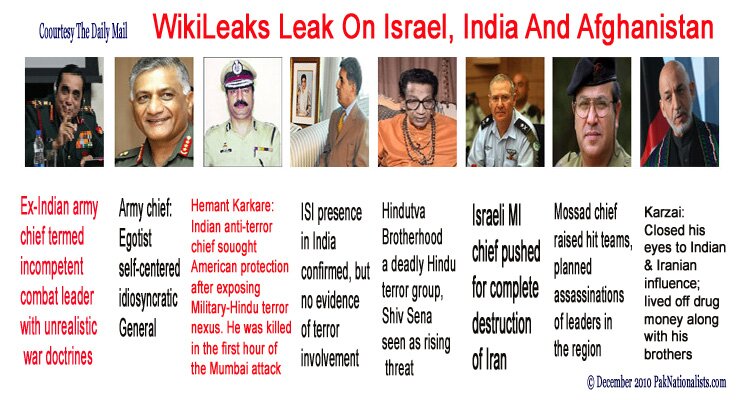
Ignore Guardian's Claim Of 'Fake' India WikiLeaks


The Guardian newspaper is claiming this report is 'fake'. Here is why you should disregard Guardian's claim for being biased:

WikiLeaks is not saying this. UK's Guardian newspaper is. It's one of 4 or 5 newspapers that have been selectively releasing the Wiki cables. About 1,200 have been released so far out of 251,000 or so. Guardian and others have manipulated the leaks to release material that supports US policy on Pakistan, specifically on Pakistani nukes and Pakistani policy on Afghanistan, India and Kashmir.

This selective approach was not limited to Pakistan. It extended to countries such as Russia and China, in addition to Pakistan, countries with whom US foreign policy is at odds.

WikiLeaks handed over the entire stash of cables to these 4 or 5 newspapers. What these papers did is to hold off everything and target these few countries in a surprising overlap with US objectives.

So the good work of WikiLeaks has been hijacked by these newspapers, including the Guardian.

Now there is this story in the Pakistani media and The Guardian is horrified that there is someone else practicing manipulation besides them.

Substantial parts of the story in Pakistani media is correct. It's only that The Guardian and the other newspapers are misleading the world public opinion by a selective focus on the things they want from WikiLeaks cables.

WikiLeaks did a good job of exposing US bully diplomacy, and here comes NYT, Guardian and 2 or 3 other 'partner' newspapers of WikiLeaks to selectively release the material to suit US policy objectives.


Tuesday, November 30, 2010

Kayani's Briefing: Dawn's Shoddy Journalism


A Dawn newspaper columnist Cyril Almeida has just given a new twist to the term fifth-columnist.

Today he has published a lousy piece of journalism that should be manadatory reading in schools across the country for pitfalls to avoid in a media career.

Far from journalistic curiosity, the only purpose of the piece appears to be to embarrass Pakistan Army Chief of Staff in his relations with key officials in US government. Columnist Almeida extensively quoted from a background briefing and turned inaccuracies into policy statements. Thankfully, he didn't forget to add, "All comments were made strictly on the condition of anonymity being maintained."  Oh really?

Mr. Almeida apparently was one of four-dozen editors, talk-show hosts and columnists invited by Pakistan Army Chief Gen. Ashfaque Kayani to his office on Sunday for an informal and off-the-record chat on the country's strategic situation. From the accounts of most of those who attended the dinner, Gen. Kayani spent a lot of time explaining the defense and army budgets and then delved into regional military issues when some of his guests went that way during Q&A.

All discussion was strictly a 'backgrounder', meant to help journalists get a better context for regional developments. Organizers of the event stressed several times to all participants not to report on the event and not to quote.

One can debate how much a journalist should or shouldn't stick to such official restrictions on information. What is beyond debate is the fact that Pakistan faces a very difficult and deteriorating strategic situation thanks to the blunders of our own and of some of our allies. If a senior official is candidly sharing information and context with Mr. Cyril Ameida and others, then Mr. Almeida, both as a journalist and as a citizen of the country, has the responsibility to reciprocate trust by controlling his urge to leak, especially when the information he just received deals with diplomacy and war and is not as urgent as exposing corruption and underhand deals.

Surprisingly for a professional journalist like Almeida, he tried to hide Gen. Kayani's indentity by identifying him only as a 'senior military official. Then he wrote, "The comments were part of a wide-ranging briefing given to editors, anchors and columnists on Sunday." 

So much for being discreet.

There was advance knowledge the army chief was arranging such a meeting. Several national dailies whose editors were invited ran brief stories on the meeting before it occured. So Mr. Almeida's 'source' was easily exposed.

Like the rest of us, a reporter at the Indian television news channel NDTV had little trouble figuring out the indentity of Almeida's 'senior military official'. The Indian channel reported, "[Dawn] did not name the military official but other media reports said army chief Gen. Ashfaq Parvez Kayani had briefed a select group of journalists."

The most damaging aspect of this kind of a leak is accuracy, or the lack of.  Mr. Almeida inaccurately reported on several points. For example, he said Mr. Kayani "claimed the country has transited from the ‘most sanctioned ally’ to the ‘most bullied ally’” of the US. While absolutely true, many of the participants are not sure they heard the Pakistani military commander make such a direct statement. Disappointingly for many, Gen. Kayani was very mellow and diplomatic, to quote one participant, presenting facts and policy statements and leaving interpretation to the listeners. Several journalists tried to drag him into spilling the beans, provoking him by questioning the timing of the meeting and try to link it to he Wikileaks story, or the start of Gen. Kayani's second three-year tenure, or the intricacies of Pakistani domestic politics. The general wound't have any of it.

Regular backgrounders by the country's leadership for the dynamic Pakistani media is a welcome step. The media has shown maturity and restraint in dealing with the issues covered in the latest briefing. State media managers in Islamabad and Rawalpindi need to improve the methods of delivery of background information, possibly streamline it in accordance with the latest best practices in public diplomacy methods. Often Pakistani media trails behind its peers in other nations like China, Iran, US, Russia and others in terms of the quality of current background information available to media professionals. Pakistan is a late entrant into this field and it would take stakeholders time to get a handle on it.

This is why Mr. Almeida's hiccup is an indiscretion that encourages forward momentum with improvements in the delivery of information to the Pakistani media in the future.
        

Monday, October 25, 2010

Relax Gen. Singh, You're No Mike Mullen


India Army Chief has confirmed that Pakistan's nuclear arsenal is safe, lucky for all Pakistanis. We were worried he'd make a negative assessment but thank God -- or Krishna, in this case -- that India rushed to stand by Pakistan and debunk the motivated American claims on the subject.

Last week Gen. V. P. Singh said Pakistan posed a threat to India. After all, it was Pakistan that invaded India without provocation in 1971 and conspired to break away half of its territory. And it is Pakistan that is the larger country, casting a shadow over India and threatening it of another unprovoked invasion any day. And it is Pakistan that is spending $30 billion in just two years to buy latest weapons, most of them aimed at Pakistan. India is totally justified in being worried about Pakistani threat. Indeed.

After this statement, the GHQ, the General Headquarters of Pakistan's armed forces, and the Pakistani strategic community, were deeply worried about Gen. Singh's next statement. We all knew it would make or break Pakistan's international reputation. And then comes this friendly statement to put all Pakistanis at ease.

Gen. Singh and his immediate predecessor, Gen. Kapoor, started something new in India. Indian army chiefs never made public statements about foreign policy issues. The US military chief, Adm. Mike Mullen, makes such statements too. But he does so because his military has bases and soldiers all over the world. India doesn't.  And yet Gen. Singh and the previous noise-maker Gen. Kapoor began this trend in India. Why? Because they were told to do so. It is part of Indian government's plans of projecting India as the next superpower, like they did with the other pooper, the Commonwealth Games Delhi 2010. New Delhi wants to put everyone on notice that Indian military chiefs make statements about any country, openly, just like the US CENTCOM chief does. Get it?

Except that, I would just humbly submit to the exalted office of the Indian Army Chief that: Let it rest, Gen. Singh. You're no Mike Mullen.


Sunday, October 24, 2010

Sorry, India, You Can't Be A Superpower With A Brain Of A Mouse


India is a big country with the brain of a mouse. Take this headline from India’s largest newspaper, Times of India: Obama Mission: Billions To Pakistan, Billions To India.

I love the headline. It’s not wrong but a little exaggerated. US President Obama is offering $2 billion’s worth of military hardware purchases to Pakistan, subsidized by US government.

For Pakistan, it’s a cautious welcome. Nothing will come to us immediately. The purchases are divided over the next five years. It will be a slow process, involving government red tape, politics and the usual arm-twisting that Washington is so good at. It’s also a lollypop that the US government has dangled before the Pakistani military to calm some of the anger over a US helicopter killing three Pakistani soldiers three weeks ago.

The Indian government knows all this. It also knows that recent US sale of F-16s to Pakistan came with a harsh condition: the planes will be accompanied by US ‘minders’ as part of support staff who will live on the base and ensure Pakistan does not ‘misuse’ the planes, as in against India.

Still, two weeks before Obama lands in India on an official visit, Indian media managers leaked this fabulously-titled but well-researched report, grumbling that billions of Indian dollars will be going to US pockets while Pakistan will be getting billions’ worth of weapons for free. Of course, even if Pakistan buys up all the $2 billion’s worth of US weapons immediately and not over five years, it will still not match India’s massive weapons shopping spree worth $30 billion, to be spent by 2012, meaning within the next two years.

This tells you one thing: the Indian government is really not worried about the puny $2 billion offer to Pakistan tipping the scales. We can’t match India’s $30 billion.

If that is clear, then what is it that India is worried about? Why whine about two billions to Pakistan over five years when India is spending fifteen times that figure in less than two years?

It’s just India’s small-minded pursuit of anything that would undermine Pakistan. There is no way Pakistan would ever invade or destroy India, nor are most Pakistanis interested in this proposition. It’s always the bigger countries that destroy smaller ones. Yet India doesn’t really miss a second seizing any opportunity to hurt Pakistan. Remember 1971 when peaceful Pakistanis were busy in post-elections noise? India launched an unprovoked invasion of Pakistan and, as the invasion unfolded, we discovered the Indians had actually planned it for two years and created and recruited a proxy army inside our country to help them once the invasion started.

The mindset behind the Times of India story is the same mindset that invaded us in 1971, the same mindset that refuses to resolve Kashmir and pave the way for peace, the same mindset that exploits Afghan mess to set up training camps to export terrorists to Pakistan, the same mindset that plants terrorism in Balochistan, and the same mindset that bans Pakistani TV channels across India.

And to confirm the height of this Indian small-mindedness, it is the same mindset that bans Pakistani visitors from posting comments on Indian news websites, no matter how respectful that comment is, if the comment questions official Indian positions on any question. [Let me also add that Pakistani guest columnists are banned in mainstream Indian newspapers for the same reason. Compare that to Pakistani generosity as our newspapers permit guest Indian columnists to write freely even if they criticize official Pakistani policies, and no Pakistani news website bans Indians surfers from posting comments.]

Our American friends can’t see this Indian small-mindedness, of course. That’s why we hear US officials insisting India is not a threat to Pakistan, the latest such gratuitous advice came just this week during the Pak-US strategic dialogue currently underway in Washington.

For Pakistan and India to live in peace, even resolving Kashmir won’t help if India doesn’t get itself a new mindset, big and confident, in contrast to the existing insecure, small-minded way of looking at its smaller neighbors.

NOTE: Not a single Indian visitor to Pakistan, whether a private citizen, government officer or an Indian artist, was ever harassed by Pakistanis in any way in the entire history of Pak-Indian relations. The legendary Pakistani hospitality always embraced and touched visiting Indians as is the case with other foreigners visiting Pakistan.

In comparison, Pakistanis are regularly harassed and intimidated and in some cases even physically attacked while visiting India.

The biggest example is how 60 Pakistanis were burned alive aboard the so-called Samjhota (Friendship) Express train when they believed calls for peace and headed to India in February 2007. Today, the Indian government has admitted Hindu terrorists, including two serving Indian military officers, were behind the gruesome murder. The Indian government, backed by American and British media, insisted immediately after the attacks that they were the work of Pakistan's ISI and Kashmiri freedom groups.

There are more recent examples. Here are two of them to prove this point:

- Bigg Boss planning to send back Pakistani Artists : Pakistani participants in an Indian TV show face life threats by Hindu terrorists. The Indian government and people are unable to protect them.

- Pakistani artist beaten up in Mumbai: A well known Pakistani comedian Shakeel Siddiqui has been tortured by some extremists in Mumbai and ordered to urgently depart from India.

There is a mindset in India, in powerful circles in government, the military and the Hindu terror groups, that can't live with a smaller western neighbor that poses no existential threat to India.

This record of anti-Pakistanism in India contradicts the ridiculous statements of US officials and think-tank types who lecture Pakistan that India is not a threat.